Cart
0
Estimated delivery: 3-5 Days
 Get Support, Call us at
96878 07999
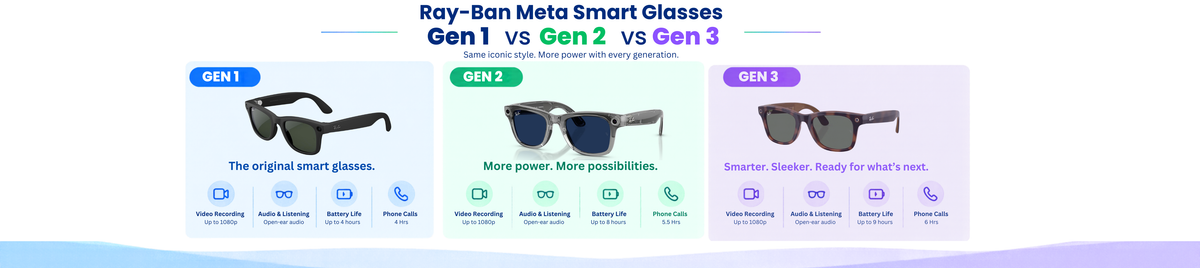
Meta has transformed the smart glasses market with its Ray-Ban collaboration. These glasses have become the #1-selling AI glasses in the world, with millions of units sold since launch. Now, with the introduction of the third-generation model at Meta Connect 2026, potential buyers face an interesting dilemma: should they opt for the upgraded Gen 3 or save money with the Gen 2? This comprehensive comparison will help you make an informed decision.
|
Feature |
Ray-Ban Meta Gen 1 |
Ray-Ban Meta Gen 2 |
Ray-Ban Meta Gen 3 |
|
Price |
Starting price was Rs. 29,900 (However, Generation discontinued since the launch of Gen 3). |
Starting at Rs. 39,900 |
Starting at Rs. 44,300 |
|
Styles |
Wayfarer, Skyler |
Wayfarer, Skyler, Headliner |
Wayfarer, Aviator and Zena |
|
Weight |
~48–50 grams |
~50–53 grams |
~50-54 grams |
|
Video |
1080p at 30fps or 60fps |
Up to 3K Ultra HD at 30fps or 1080p at 60fps |
Up to 3K Ultra HD at 30fps or 1080p at 60fps |
|
Battery Life |
Up to 4 hours |
Up to 8 hours |
Up to 9 hours |
|
Charging Case |
32 additional hours |
48 additional hours |
50 additional hours |
|
Total Battery |
36 hours |
56 hours |
59 hours |
|
Audio Playback |
3.5 hours of continuous audio |
Up to 5 hours of continuous audio |
Up to 6 hours of continuous audio |
|
Phone Calls |
4 hours of continuous calls |
5.5 hours of continuous calls |
6 hours of continuous calls |
|
Meta AI |
Yes |
Yes (enhanced) |
Yes (enhanced) |
|
Live Translation |
Yes |
Yes (expanded languages) |
Yes (expanded languages) |
|
Conversation Focus |
Yes |
Yes |
Yes |
|
Hyperlapse/Slow-Mo |
N/A |
Yes |
Yes |
|
Prescription Lenses |
Yes |
Yes |
Yes |
As Ray-Ban Meta Gen 3 entered the market, the Gen 1 glasses have been discontinued and are no longer sold new. We have kept the Gen 1 model here to help you better understand how the latest model compares against the newer ones. Therefore, if you want to purchase Ray-Ban Meta glasses, then you can either opt for the Gen 2 or Gen 3.
Ray-Ban Meta became the first product to make smart glasses mainstream, selling over two million units since their debut in 2023. The original model proved that consumers were ready for stylish AI glasses that didn't compromise on design. Building on this success, Meta has introduced improvements that address the most common complaints while maintaining the iconic Ray-Ban aesthetic.
In late September 2026, Meta launched the Ray-Ban Meta Gen 3 glasses during the Meta Connect event 2026. This event by Meta highlighted major breakthroughs in AI agents, smart glasses and VR hardware.
This is where the Gen 2 and Gen 3 completely overtake Gen 1. They feature a 12 MP ultra-wide camera with a 100° field of view, supporting up to 3K Ultra HD at 30fps or 1080p at 60fps, delivering sharper, smoother, and more vivid videos with ultrawide HDR.
By comparison, Gen 1 supports 1080p recording at 30fps or 60fps, which is great for casual use but falls short for high-quality content creation.
The higher resolution and frame rate options make Gen 2 and Gen 3 particularly appealing for action shots, sports recording, and any scenario involving movement. Later this fall, hands-free filming is getting upgraded across all Meta AI glasses with two new capture settings: hyperlapse and slow motion.
While the camera resolution stays the same between Gen 2 and Gen 3, one notable difference is the size of the camera. In Ray-Ban Meta Gen 3, the camera and LED opening are 36% smaller in size compared to the Gen 2 model.
All three of these generations sport the same 12-megapixel ultra-wide camera with a resolution of 3024 x 4032 pixels for photos. The image quality remains consistent between models, delivering crisp, wide-angle shots perfect for capturing moments hands-free.
Gen 3 stands out from its predecessors with its dynamic photo feature. Unlike the Gen 2 model, which only takes standard shots, Gen 3 expands the landscape capture modes alongside standard framing.
All three generations include 32GB of storage, which is sufficient for approximately 1000 photos and 100+ 30-second videos before you need to transfer content to your phone.
Gen 3 adds the Aviator and Zena to the original Wayfarer design. Moreover, the frames are also slightly slimmer with adjustable temple tips and fully customizable action buttons.
Both Gen 1 and Gen 2 maintain virtually identical designs, which is excellent news for fashion-conscious buyers. You can choose between Wayfarer, Skyler, or Headliner styles depending on which you prefer, but these frames will look virtually identical across the Gen 1 and Gen 2 models. Each style features a camera on one side and an LED privacy indicator on the opposite side.
The frames are available in multiple colors, with options for polarized, transitions, and prescription lenses. All three of these generations support prescription lenses, making them accessible to a wide range of users.
Here's where we see a subtle but meaningful improvement. Meta managed to shave a few grams of weight off the frames. The Generation 3 of smart glasses weighs ~50–54 grams, up from ~48–50 grams on the Gen 1 model and ~50–53 grams on the Gen 2.
All three of these models feature an IPX4 water-resistance rating, meaning they can handle splashes and light rain but shouldn't be submerged.
The most significant improvement between generations is battery performance. Gen 3 glasses can run straight for 9 hours on a full battery. Moreover, the case has a battery life of 50 hours, which brings the total battery life to an outstanding 59 hours.
This increase in battery life addresses one of the most common complaints about the Gen 1. You can now:
Record more videos without worrying about power
Listen to music throughout your workday
Use Meta AI features more liberally
Charge less frequently
The Ray-Ban Meta Gen 1 has a 160 mAh battery and is capable of up to 4 hours of use on a single charge. With the charging case, you can get up to 32 hours, contributing to the improved video quality. The Gen 2 can achieve up to eight hours, plus the case gets an additional 48 hours of charge too, bringing the total to 56 hours.
All of these models charge to 50% in just 20 minutes, which is convenient for quick top-ups.
The three generations of Ray-Ban Meta AI glasses deliver immersive sound and clear communication, but Gen 3 offers slightly better endurance:
2 custom-built open-ear speakers for music, calls, and notifications
Custom 5-microphone array for high-quality audio recording
Up to 3.5 hours of continuous audio playback
Up to 4 hours of continuous phone calls
2 custom-built open-ear speakers with improved audio tuning
Custom 5-microphone array for immersive audio recording
Up to 5 hours of continuous audio playback
Up to 5.5 hours of continuous phone calls
2 custom-built open-ear speakers with improved audio tuning.
Custom 6-microphone array for immersive audio recording.
90%+ background-noise reduction.
Prepared for future Dolby Atmos.
Up to 6 hours of continuous audio playback.
Up to 5.5 hours of continuous phone calls.
The open-ear design ensures you can enjoy content while staying aware of your surroundings. Additionally, Conversation Focus, coming soon via software update, will amplify the voice of the person you’re speaking with while reducing background noise.
The three generations benefit from Meta's continuous software improvements. There are huge new features coming via a Meta AI software update to both Gen 2 and Gen 3 smart glasses, including:
Live Translation: Expanding the ability to translate conversations in real-time with new languages, including German and Portuguese.
Conversation Focus: Amplifies the voice of the person you're speaking with while reducing background noise.
Upgraded Meta AI: General improvements to the assistant, including better conversational flow and the ability to ask questions about what you're seeing.
These generations are built on the Qualcomm Snapdragon® AR1 Gen 1 platform, ensuring powerful performance and smooth AI-driven experiences. This advanced chipset enables features like real-time translation, enhanced conversational flow, and intelligent scene recognition.
In practical terms, Gen 2 and Gen 3 will receive the same AI capabilities through software updates, so users can expect consistent improvements over time. In current terms, Gen 3 has improved Meta AI access, along with customizable buttons. Gen 1, on the other hand, will only receive selective updates.
All three generations of Ray-Ban Meta AI glasses support:
Wi-Fi 6
Bluetooth 5.3
Compatibility with iOS and Android devices
You'll need to pair the glasses with the Meta View app, which requires linking to a Meta account (Facebook, Instagram, or Meta/Oculus account).
Ray-Ban Meta Gen 1: Starting price was Rs. 29,900. However, the generation has now been discontinued.
Ray-Ban Meta Gen 2: Gen-2 has launched in India around ₹39,900
Ray-Ban Meta Gen 3: The price of Gen-3 collection ranges from ₹44,300 to ₹50,100
Disclaimer: The final cost for Ray-Ban Meta AI glasses may require an additional cost for polarized, transition and prescription lenses.
The Ray-Ban Meta Gen 1 smart glasses were around at Rs. 29,900. Skyler and Wayfarer. However, the Gen 1 glasses have been discontinued
The Ray-Ban Meta Gen 2 smart glasses are available at Rs. 39,900 in all three styles (Wayfarer, Skyler and Headliner) with full customization options.
The Ray-Ban Meta Gen 3 collection is available at Rs. 44,300 with three different styles, Wayfarer, Aviator and Zena
Definitely Gen 1 owners should upgrade to Gen 3 for higher battery life, enhanced video quality and advanced Meta AI features.
Yes, Gen 2 owners should upgrade to Gen 3, as the newer generation has a better battery life, audio quality, new AI features, audio playback, customizable action buttons and prescription range.


Selling Out Fast


Sunglasses do more than complete your look—they protect against UV damage, eye strain, and early aging. Discover the eye health benefits of wearing sunglasses.

With the sun's harmful UV rays threatening their delicate eyes, prescription sunglasses for children are an excellent solution. This blog will explore the advantages of prescription sunglasses for children.

Understanding your eyeglass prescription is key to maintaining good eye health. This guide explains how to read your prescription and what the different terms signify.
New Glasses could mean any of the following scenarios: You have been prescribed spectacles for the first time, and you...